The transformation of egg whites from a viscous liquid to a voluminous foam is one of the most fascinating chemical processes in baking. At its core, this alchemy relies on the denaturation and reorganization of ovalbumin proteins when subjected to mechanical force. For pastry chefs and home bakers alike, recognizing the precise moment when whipped egg whites transition from wet peaks to dry peaks often marks the difference between a collapsed soufflé and one that soars.
In their natural state, egg whites resemble a sticky, translucent gel with distinct strands of chalazae clinging to the yolk. When first introduced to a whisk or beater, large air bubbles form haphazardly, creating a frothy but unstable mass. This initial stage bears little resemblance to what we typically consider "whipped," with bubbles that burst easily and leave behind a watery residue. The true magic begins as the mechanical action starts unraveling the complex tertiary structures of globular proteins, allowing them to form new bonds around air pockets.
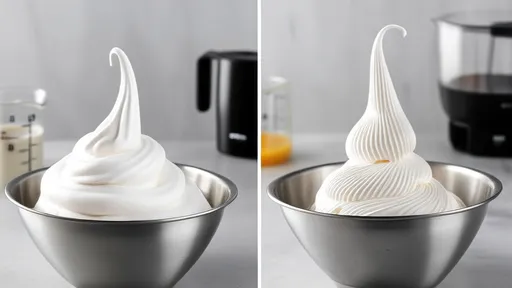
The wet peak stage emerges when the whites have developed enough structural integrity to hold their shape momentarily, yet still maintain a glossy, fluid quality. Dip a whisk into the bowl and lift it vertically - the peaks that form will curl over like the soft waves of molten glass, their tips bending under their own weight. This marshmallow-like consistency proves ideal for delicate applications where some flow is desirable, such as the base of angel food cakes or the folding stage of French macarons. The foam at this juncture still contains relatively large air cells, visible as irregular pockets when smeared across a light-colored plate.
As whipping continues, the proteins undergo further reorganization, shedding water molecules and creating an increasingly tight network. The once-glossy surface begins to take on a matte appearance, signaling the evaporation of excess moisture. Here lies the critical window where mere seconds separate perfect stiff peaks from the grainy, overwhipped desert that dooms meringues. The foam's architecture changes dramatically - air cells become uniformly small, refracting light to give the mass a bright white opacity rather than the translucent sheen of earlier stages.
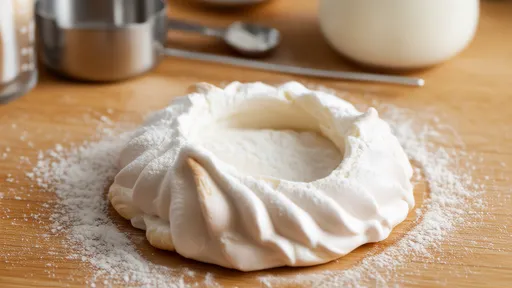
Dry peaks announce themselves with an almost defiant rigidity. When the whisk is lifted, sharp mountain ranges stand at attention without so much as a quiver at their tips. Rub a pinch between your fingers, and the absence of slipperiness confirms what the eyes suggest: the proteins have fully embraced their new role as architects of air. This is the stage for piped meringue cookies and the structural foundation of pavlovas, where every extra second of whipping risks crossing into the dreaded "overbeaten" territory that leads to weeping and collapse.
Professional kitchens often employ the "bowl test" to verify dry peak status - inverting the mixing bowl overhead to demonstrate the foam's refusal to budge. While theatrical, this method pales in reliability compared to the subtle visual and tactile cues. Overwhipped whites take on a cottony, broken appearance as the protein matrix begins expelling its liquid payload, creating visible yellow-tinged puddles in the mixing bowl. At this point, no amount of gentle folding can restore the delicate balance required for most applications.
Temperature plays a surprising role in these transformations. While cold eggs separate more cleanly, room temperature whites whip faster and achieve greater volume as the relaxed proteins unfold more readily. Copper bowls, long favored by classic French chefs, actually catalyze the formation of sulfur bonds that stabilize the foam - a fact modern science has confirmed, though stainless steel with a bit of cream of tartar achieves similar results. The very tools we use alter the process; balloon whisks incorporate air more gently than flat beaters, producing different bubble structures even when reaching the same final peak stage.
Understanding these visual milestones transforms baking from rote recipe-following to an intuitive art. The difference between a properly whipped meringue and an inferior one often comes down to recognizing that fleeting moment when the foam transitions from wet to dry - when the last vestiges of liquidity vanish into a stable, snowy mass capable of supporting spun sugar fantasies. Mastery of these stages separates the competent baker from the true pastry artist, turning a simple mixture of albumen and air into edible architecture.
By /Jun 18, 2025
By /Jun 18, 2025
By /Jun 18, 2025
By /Jun 18, 2025
By /Jun 18, 2025
By /Jun 18, 2025
By /Jun 18, 2025
By /Jun 18, 2025
By /Jun 18, 2025
By /Jun 18, 2025
By /Jun 18, 2025
By /Jun 18, 2025
By /Jun 18, 2025
By /Jun 18, 2025
By /Jun 18, 2025
By /Jun 18, 2025
By /Jun 18, 2025
